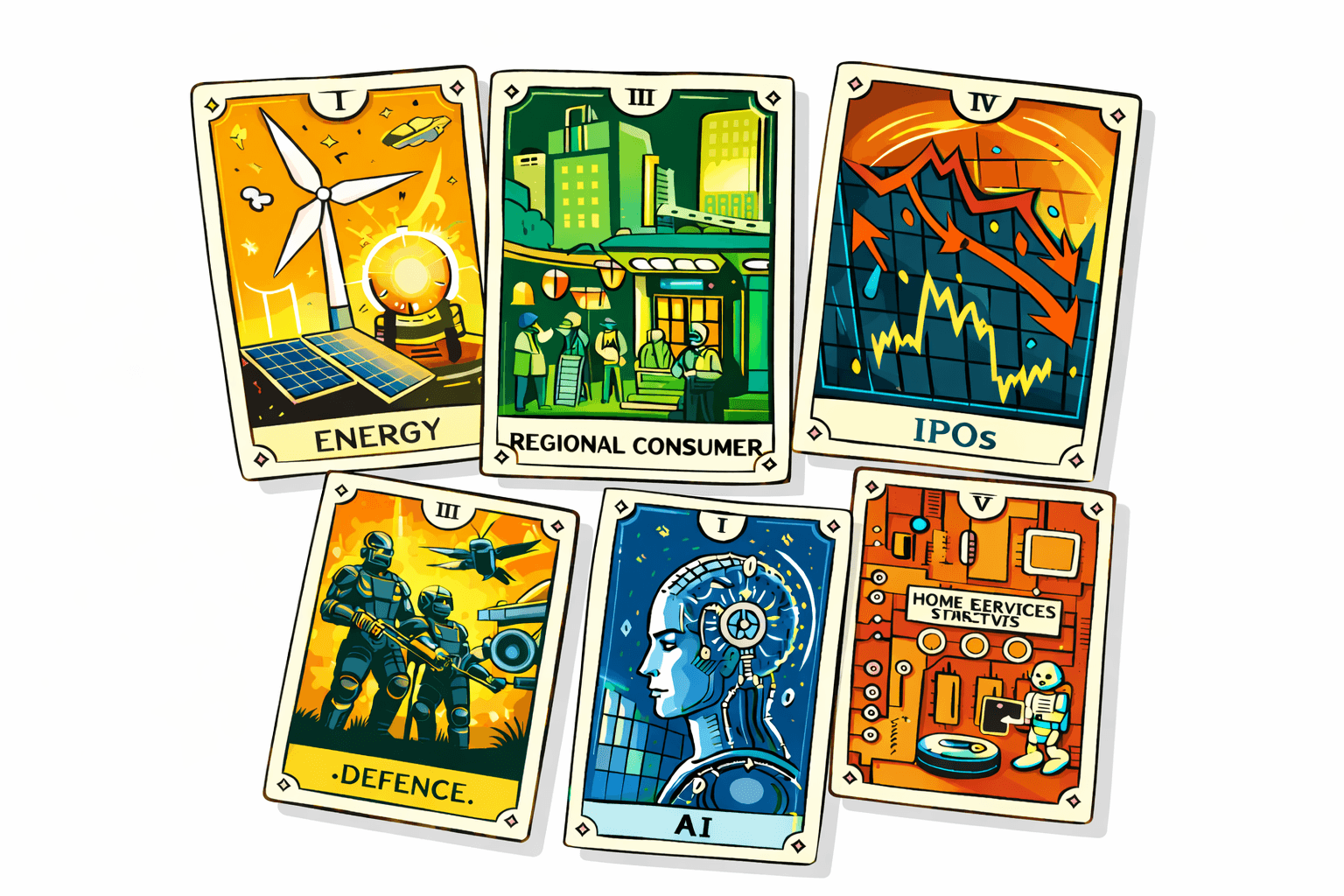
Mimetically Predicting 2026
B2C
B2B
Venture Capital
Profile
It has been an interesting year.
The 2020s, which began with a once‑in‑a‑generation pandemic, are now deep into an age of permanent volatility. Wars that started earlier in the decade refuse to end. New flashpoints emerged, from the Red Sea to the Taiwan Strait. Inflation cooled on paper, but food and fuel still felt expensive for most people.
Markets reflected this confusion. Equity momentum stalled and restarted unevenly. Crypto oscillated between irrelevance and resurgence. AI moved from wonder to workload. Consumers spent, then stopped. Convenience mattered, but so did price, trust, and reliability.
India’s public markets lived through both moods at once. The Sensex and Nifty swung between euphoria and correction, yet primary markets stayed busy. 2025 became one of the most active years for IPOs worldwide. Tech, industrials, retail and jewellery all lined up on Dalal Street.
On our front, the year felt like a step‑function change.
ajvc went from being a content‑led experiment to a full‑fledged pre‑seed fund with a growing portfolio of 30+ companies and a fast feedback loop. We saw the ecosystem through three simultaneous lenses: builder, investor, and chronicler.
Twelve months ago, with that vantage point, we tried to read the tea leaves for 2025. Some calls were right on the money, some were early. As always, we begin by grading ourselves on last year's predictions
2025 Year in Review
#1 Quick commerce will see consolidation, funding peaking mid-year, and visible pain from competition: Albinder seemed to chime in just in time to say that quick commerce is a bubble. From the heady days of 2024, when the total fundraise was $1.5B, quick commerce dropped to $400M in 2025. Funding peaked mid-year, and competition from Amazon, BigBasket, and Reliance entered. Dunzo died. One player has consolidated 50%. (9/10)
#2 Vertical-focused AI will see ₹4,000 Cr+ of funding, with 100+ startups disrupting the SaaS model: Funding shifted decisively from infra and base models to application-layer, workflow-specific AI agents across BFSI, legal, insurance, pharma, retail ops, and HR. “Services-as-software” moved from theory to real enterprise adoption. Total funding was at 5,6000 Cr. More than 200 companies started. Spotdraft, Composio, Greylabs led the way (10/10)
#3 Fintech will not be in India’s top three most-funded sectors in 2025: Fintech dropped to #4 in funding in 2025, behind consumer tech, AI/SaaS and retail for the first time. The category faced severe headwinds, primarily because funding from prior years had been absorbed. Fintech’s largest round was a $100M by Raise/Dhan, which would rank the 32nd largest round in the last 5 years in fintech. The category really dropped (10/10)
#4 10+ startups will IPO in 2025 with 50% being profitable: 18+ startups IPOd, 40% higher than 2024. Companies are listed across consumer internet, SaaS, marketplaces, industrial platforms, and finance. Groww, Urban Company, Lenskart, Meesho all debuted well. The key shift versus earlier cycles was quality. 9 came with positive EBITDA or near-term profitability that public markets could underwrite. Extra points for slam dunk (11/10)
#5 Jewellery startups will raise more than ₹2,000 Cr in funding, with five new startups debuting. Jewellery moved from an under-analysed niche to a serious venture category. Bluestone’s IPO alone unlocked over ₹1,500 Cr, GIVA raised 500 Cr, Aukera raised 100 Cr, Palmonas raised a big 50 Cr round. 7 startups like Nuyug, Coluxe, True Diamond and more started. The category continued to scale (10/10)
#6 Manufacturing tech will see one IPO and ₹2,000 Cr of funding. SEDEMAC filed for an IPO in November 2025. Zetwerk filed for a 6,000 Cr IPO, while also raising ₹1,200 Cr in funding. Infinite Uptime raised 400 Cr, with multiple startups like Magma, Elecbits, DesignX combining to raise 300 Cr. 2 IPO filing and 1,900 Cr in funding (9/10)
We end the year with an overall score of 9.6/10 – slightly lower than last year’s 9.8/10, but on tougher ground With that humility check out of the way, we can now attempt the foolish thing again: surprisingly predicting 2026.
Energy and storage will become a top-5 funded climate theme with Rs 1,000 crore of capital
2025 was the year when energy quietly stopped behaving like an ESG category and started behaving like a constraint. Between data centres scaling faster than expected, industrial capex coming back onshore, and urban power reliability getting stress-tested, energy moved from “nice to have” to “cannot fail.”
The rise of data centres has been the clearest tell. AI workloads, cloud demand, and enterprise digitisation have made power availability a gating factor, not a line item. If compute is the new factory, energy is the new land, and people need lots of it. We had talked about this deeply before
This has changed how capital is flowing. Instead of chasing climate narratives, investors are underwriting energy assets the way they underwrite roads, ports, and telecom towers on utilisation, uptime, and contracted cash flows. Storage economics have improved, grid-optimisation is getting real budgets, and captive power models are being designed around long-term offtake rather than policy incentives.
What is striking is who is showing up. Infrastructure funds, PE players, and balance-sheet investors are increasingly comfortable here, while traditional venture capital is becoming selective. The cheque sizes are larger, the holding periods longer, and the tolerance for execution risk lower. Energy is no longer being sold as “saving the planet”; it is being sold as a way to keep businesses running.
We expect this shift to unlock ₹1,000+ crore into storage, grid-level optimisation, captive power, and data-centre-linked energy systems. As energy sheds its climate-tech skin and puts on an infrastructure balance sheet, the question becomes simple: who owns the picks and shovels of India’s next compute and industrial cycle?
Home services will raise 1,500 Cr+ in funding, but also grind to a fundraising halt in late 2026
2025 was the year when home services stopped being a convenience experiment and became a habit. Urban households no longer debate whether to use platforms for cleaning, repairs, beauty, or appliance servicing. They debate which one they trust to show up correctly.
Yet even with an existing base of customers, quick-commerce fever has struck home services, as customers now expect house help in 10 mins. Snabbit and Pronto are duking it out as upstarts that try to eat into Urban Company’s market share. UC, which was recently listed, has taken a much more conservative approach but is still putting money to work for winning.
At one end, players like Urban Company have steadily formalised partner training and service standards, while companies such as Livspace operate almost like project managers, owning timelines, quality, and accountability end-to-end. At the other end, hyperlocal, speed-led models like Snabbit are discovering that even “instant” services need reliable supply, trained workers, and tight ops to retain users. For home services that do the servicing outside of the home scalably, infra-led models such as Iztri are building tightly controlled service networks where reliability matters more than scale.
Many of these players are re-attempting what was tried in 2015, with all companies, barring Urban Company, failing even to survive. We expect this new investor love to deploy ₹1,500 crore into home services as platforms move from “booking help” to owning quality, accountability, and speed. We also think the category will receive a lot of capital upfront at the beginning of the year, with fundraising slowing as market realities and performance demands are placed on the well-funded companies.
Defence tech will see 2,000 Cr of funding with 15+ new startups
2025 was the year when defence tech quietly stopped feeling like a startup theme and became a national project. The conversation shifted away from pilots, demos, and proofs-of-concept to contracts, delivery schedules, and execution capacity.
This has been building for a while. Border tensions have not gone away, geopolitics has stayed messy, and the push for indigenisation has moved from policy intent to actual orders. Defence demand does not behave like consumer or enterprise tech. It does not wait for adoption curves. It shows up through procurement cycles, long-term programmes, and committed budgets.
What is different this time is the depth of participation. Indian companies are no longer playing only at the edges. They are bidding for complete systems and platforms. Drone makers like ideaForge are executing meaningful government orders. Electronics and optics players such as Paras Defence and Astra Microwave Products are supplying mission-critical components across air, land, and naval programmes. Firms like Data Patterns have scaled steadily on the back of long-duration defence contracts rather than repeated fundraising cycles.
What this has done is change how capital behaves. Defence tech is no longer being underwritten like venture software. It is being viewed more as manufacturing or infrastructure. Cheques are tied to order books, certifications, and delivery capability. Timelines are longer, but revenue visibility is higher. The capital coming in is patient, and the expectations are clear.
You can already see the divergence. Large industrial groups are building out defence verticals. As procurement replaces pitch decks and contracts replace narratives, defence tech will increasingly operate outside the usual boom-and-bust startup cycles.
We expect this to pull ₹2,000+ crore into defence tech in 2026, driven by procurement-led growth and long-duration contracts rather than hype.
Regional-focused consumer brands will emerge as a top 5 theme, securing 500 Cr+ of funding
Over 60% of India’s FMCG consumption still comes from non-metro markets, where discovery happens on shelves, not screens. Regional brands with deep distributor relationships routinely deliver higher repeat rates and better working-capital cycles than national D2C-first brands.
You can already see this across categories. In traditional snacks and foods, brands like Mithila Foods, which sells products like thekua rooted in Bihar and eastern UP, have built trust by owning a narrow set of products deeply within their home markets rather than chasing national visibility. In staples and packaged foods, companies such as Aachi Masala and Sakthi Masala dominate shelves across the South through distributor strength and household loyalty, not marketing noise.
In snacks, Balaji Wafers and Bikaji show how regional dominance can translate into scale without losing price discipline. In homegrown categories like papad, Lijjat Papad remains one of the clearest examples of repeat consumption, beating any form of storytelling. In dairy and frozen foods, Vadilal continues to remind the market that cold-chain execution and relationships with retailers matter more than brand buzz.
Large incumbents have noticed this shift as well. Instead of building regional relevance from scratch, big groups are choosing to acquire or back brands that already have existing consumer bases in regions. Moves by Reliance Retail into legacy and regional brands, whether in beverages, staples, or local favourites, reflect a simple insight. Trust built over decades in regions is faster to buy than to manufacture.
Less than 10 new tech IPOs will list as the market corrects, with 75%+ public tech companies dropping from listing highs
2025 was a watershed year for Indian tech IPOs.
Large, well-known consumer and internet companies such as Urban Company, Meesho, and Lenskart found open markets and ample liquidity. After a prolonged funding winter, IPOs became the preferred exit and capital-raising route, and the market absorbed supply with enthusiasm.
But behind the scenes, a reality check began in 2025, and it will set the tone for 2026.
Once the listing-day euphoria faded, public markets became far more discriminating. Ola Electric saw sharp volatility as investors pivoted from scale stories to margins, cash burn, and operating discipline. FirstCry slipped below issue levels as timelines to profitability were reassessed. Even marquee consumer internet names like Swiggy faced pressure post listing, as competition intensity and unit economics took centre stage.
This pattern extended beyond consumer tech. Office-space and travel listings, such as Awfis and Ixigo, delivered muted post-listing performance compared to earlier IPO cycles, with stocks essentially moving sideways as markets waited for consistent execution rather than rewarding growth projections.
The message from public markets was unambiguous. Companies listing with thin margins or heavy dependence on future operating leverage struggled to sustain valuations. Those with cleaner unit economics held up better, but even they saw limited re-rating.
While several tech companies are planning to file for public listings, seeing the euphoria, the markets will not be kind. We also expect a broader-based market correction to hurt these listing prospects.
Indian AI companies will cross 6,000 Cr in funding, with a surge in individual workflow automation
2026 will be the year when AI automation stops feeling like an experiment and actually works. India will not be behind, especially on use cases where coordination, compliance, and volume matter more than novelty.
The real value from this cycle will show up at the application and workflow layer. AI automation embedded inside email, ticketing systems, CRMs, case-management tools, and internal dashboards will move into mainstream use. Adoption will not come from excitement, but from relief: fewer follow-ups, fewer handoffs, fewer things falling through the cracks. TruFides is doing it for compliance teams, Chop is doing it for finance teams.
AI automation will not only be built for enterprises, but for personal use cases. Platforms like Jaagruk Bharat are using assistants to help citizens navigate government schemes, documentation, eligibility checks, and grievances. Communication and coordination will also be one of the earliest and largest unlocks. Email, reminders, follow-ups, and prioritisation remain a hidden tax inside organisations. Tools like Faraday are attacking this problem by sitting directly inside inboxes and handling nudges, drafting, and response sequencing without requiring users to change how they work.
Over the year, every knowledge worker will increasingly have a personal assistant handling repetitive tasks such as email drafting, follow-ups, scheduling, ticket triage, basic reporting, and first-level reviews. This will free up time for higher-order work, decision-making, and final judgment rather than replacing roles outright. This will also be the year Indian AI takes off in a version of SaaS 3.0, where Indian teams become