Can ₹1,440 Cr HOCCO Build on ₹1,020 Cr Havmor for Ice Cream Sizzle?
Profile
Brand
Last month, HOCCO raised $10M in its Series B first tranche, valuing the Chona family's ice cream comeback at ₹1,440 crore, less than two years after launch.
The Spark
In 1944, Karachi was still part of undivided India.
It was a city of ports, mills, and restless ambition. British signboards lined the main roads; trams rattled toward Saddar Bazaar; and evenings carried the hum of cafés serving milky tea and bread pudding.
Among those evening cafés stood a small one run by an unassuming restaurateur - Satish Chona’s uncle. And behind its counter, after finishing his engineering shift at BOAC, a young Satish learned a different kind of precision which had nothing to do with aircrafts.
He worked at BOAC during the day. Precision was his job. At night, he tried to bring the same precision to dessert.
He didn’t have a machine. There were no cold rooms or temperature gauges. He learned through trial: stirring milk, sugar, and essence inside metal tins packed with salt and ice. Some nights, the mixture froze unevenly. Some nights it barely held shape. When a batch failed, he noted what went wrong and tried again the next day.
People noticed the difference when it worked well.
First, café regulars asked for a scoop after their tea. Then neighbours dropped by specifically for it. A few small shops in nearby lanes asked if they could keep small tubs for the afternoon. It wasn’t a company, but the product was finding its own path.
Family stories say the name “Have More” emerged casually: when someone asked for a second helping, a joke from behind the counter became a name customers started using on their own. The signboard came much later.
By 1946, the small setup needed a slightly bigger churn. They added vanilla, mango, and pistachio flavours that held up well in Karachi’s humidity. Satish kept a small diary where he wrote things most people would never think about. Questions he noted were which milk supplier produced better cream, how long a scoop would survive outdoors before melting, and how colder water from the port area changed everything.
But slowly, a habit was forming around him.
Families stopped by after dinner. Children recognised the café by the way the tin lids scraped. On Sundays, the café’s back area filled up first with tired workers, then with laughter and requests for “just one more”.
By early 1947, Satish was finally planning to scale up with a second counter, a better churner, maybe even a proper sign with the new name. The pattern of success was finally visible.
None of them knew the city itself was weeks away from being split by a border.
The Exodus
In 1947, permanence vanished.
One morning Karachi was home; by nightfall, it was a border city. Partition split streets and families alike, and Satish Chona lost everything: his café, his tools, his regulars. He left with ₹200, a few utensils, and the memory of a recipe that had once made people smile.
He tried Dehradun first. The hills were calm, but the air was too cold for ice cream. Evenings passed without customers; milk soured faster than it sold.
Frustrated but not defeated, he moved again, this time to Indore. The city was warmer, busier, and full of commerce, and he saw hope. A partner joined, sales picked up briefly, but the venture unravelled when funds and trust evaporated.
By 1951, Satish reached Ahmedabad.
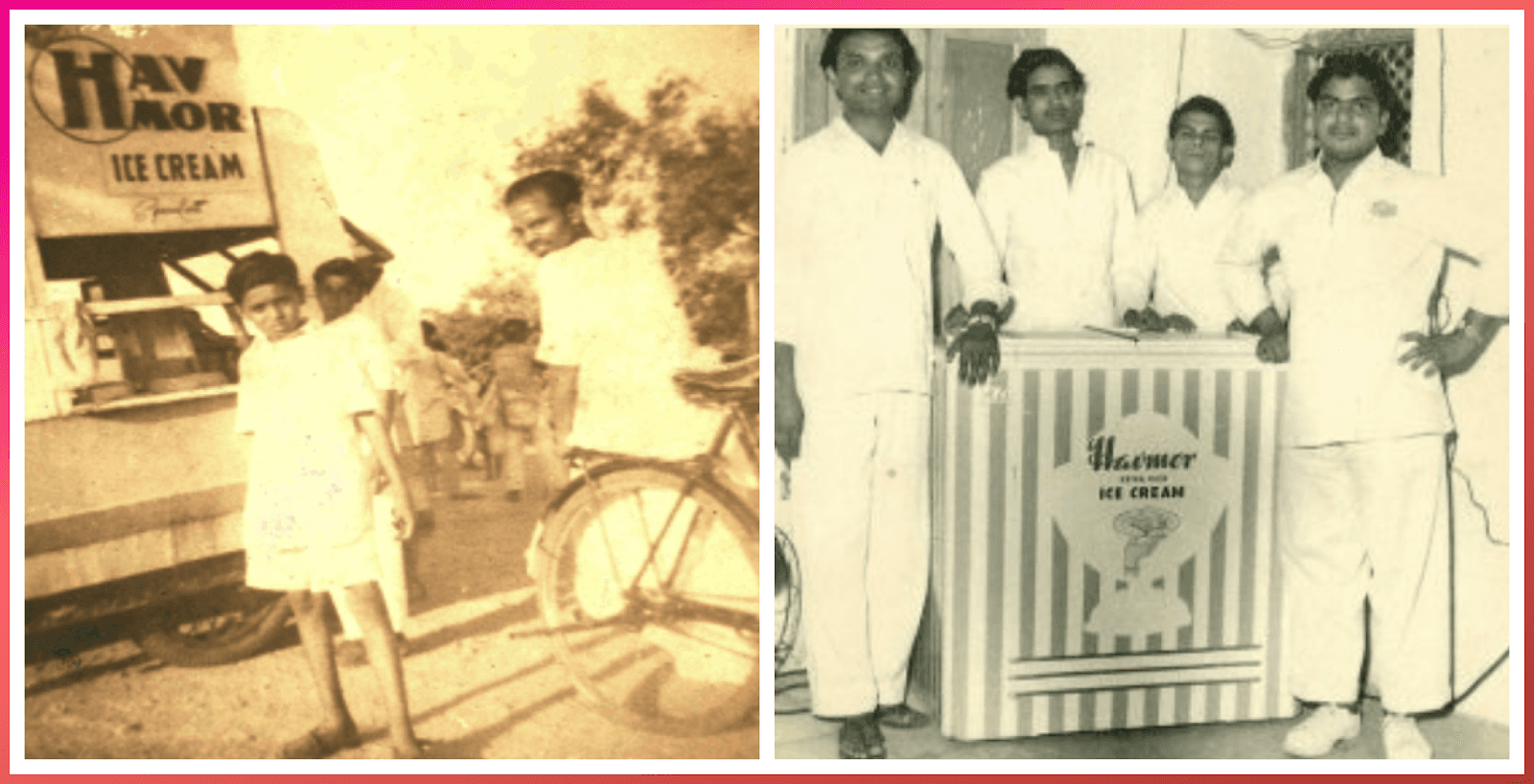
The city felt right, hot, industrious, and hungry for small comforts after long mill shifts. He built a wooden handcart, packed tins with ice and salt, and parked near the Relief Road station. The board said just “Ice Cream ₹5.” He churned ice cream through the heat.
People paused, tasted, and returned the following evening.
Word spread. Ahmedabad’s heat had met its perfect relief. For the first time since Karachi, Satish saw a line form again, this time in a city he barely knew.
He had lost a country but rebuilt a company. This time, it stood on faith, flavour, and the certainty that resilience could be frozen, scooped, and sold.
The Foundation
By 1953, Satish Chona finally had a roof over his dream.
The wooden handcart outside the railway station became a small shop on Relief Road, thanks to industrialist Kasturbhai Lalbhai. The only rule was no eggs on the premises.
For Satish, that condition was more than a lease term. It became the foundation of Have More’s identity, pure, vegetarian, trustworthy.
Ahmedabad embraced the store immediately. Mornings began with churning fresh batches of ice cream. Afternoons were spent preparing tins and cones. Evenings turned into gatherings. Factory workers, students, and families lined up for a scoop after dinner.
Satish kept the operation small but disciplined. He believed in serving only what he could make fresh. When a batch ran out, he closed for the day. The scarcity added charm. People planned their evenings around the store’s timing. It was no longer about selling ice cream. It was about creating a routine the city could rely on.
As demand grew, Satish expanded cautiously. He added more flavours, hired local help, and began storing ice using insulated containers lined with salt. He learned to buy milk early in the morning, before the heat spoiled the cream. Each night, he recorded notes on which flavours sold fastest and which batches melted too soon.
He saw a system begin to form.
By the early 1960s, Have More had become a familiar name across Ahmedabad. Families ordered tubs for weddings and birthdays. Cafés in nearby markets stocked his ice cream by the kilo, all without any advertisements.
Around this period, the name evolved. The painted signboard on Relief Road dropped the space between the words. Have More became Havmor. The change was practical at first, shorter and easier to fit, but it also gave the brand a distinct identity.
Satish’s focus never drifted toward national expansion or expanding outside Gujarat. He wanted the product to remain reliable in areas where demand had already been proven. Weddings and family gatherings began ordering in bulk. Regulars brought visiting relatives to show them the taste they grew up with.
By 1965, Havmor had become more than a store. It was part of the city’s rhythm. A familiar corner where people met, talked, and waited for a scoop that tasted the same every time.
Satish had started with nothing. Within a decade, he had built something that no amount of money could buy—trust.
That trust lay the foundation of a legacy that would outlive him.
Slow Craft
By the mid-1960s, Havmor was no longer just the Relief Road shop.
It had become a familiar part of Ahmedabad’s evenings, and the demand was steady enough to support more locations.
For Satish Chona, the next step was to build endurance. He knew what failure felt like. He had seen businesses collapse from ambition without discipline. So instead of chasing new cities, he focused on building systems that could last.
He began training his small team in the same discipline that had kept him steady through chaos. The rule was simple: if you would not serve it to your own family, do not serve it to anyone. He maintained handwritten ledgers of daily production. Every batch had to taste the same, even if the weather changed.
By this time, Pradeep Chona, Satish’s son, had joined him. Pradeep was different. Where Satish saw craft, Pradeep saw the process. He noticed that customers waited longer on weekends, that flavours ran out too soon, and that word of mouth could be more predictable if they managed inventory better.
He began documenting recipes, measuring quantities, and building small temperature-controlled storage rooms. For the first time, Havmor started to to look like a proper company.
The family’s guiding philosophy remained unchanged - serve less, serve better. But Pradeep added one more layer: serve faster. He experimented with hand-operated machines to churn multiple batches at once and created simple shifts to reduce waiting time.
Competitors like Amul and Vadilal were scaling heavily during these years with factories, broader distribution and promotional campaigns. Havmor did not enter that race. It concentrated on Gujarat, keeping distances short and consistency high.
The strategy meant slower store-count growth, but fewer quality fluctuations and lower waste.
Throughout the 1970s, Havmor opened kiosks in local hubs such as Shahibaug and Navrangpura. Trusted employees managed these locations, many of whom stayed for decades. That continuity helped maintain loyal customer bases in each area. This human chain became Havmor’s invisible infrastructure.
As the city modernised, so did the palate. Families began asking for chocolate, coffee, and nut flavours. Pradeep experimented cautiously, introducing new flavours only after weeks of testing.
His view was clear: every scoop should taste like Havmor, even when it was something new.
By the early 1980s, Ahmedabad had changed. Textile mills had slowed, and a new middle class was emerging: professionals, students, and small business owners with higher expectations and broader tastes. Pradeep saw an opportunity, ice cream had built trust; now it could open the door to food.
In 1983, he launched Havmor’s first restaurant, a casual dining space that served pav bhaji and chole bhature and ended every meal with a scoop of ice cream. It was a bold step, but it worked. The restaurant was full from day one.
From that point on, Havmor was no longer just an ice cream brand. It had become a family institution, one that combined the warmth of tradition with the precision of process.
Over nearly two decades, the business maintained its cautious approach and operational discipline rather than chasing rapid geographic expansion.
That foundation would serve Havmor when it scaled later.
Revolution
By the early 1980s, Ahmedabad was changing.
Textile mills that once defined the city were slowing down. Malls hadn’t arrived yet, but a new kind of weekend culture had families going out to eat. Dining out was no longer a luxury. It was leisure.
For Pradeep Chona, this was the moment to evolve Havmor from a brand you ate at home to a brand you experienced together. Ice cream had built trust. Now food could build community.
In 1983, he opened Havmor’s first restaurant near the original store on Relief Road. It was small, brightly lit, and simple, with red chairs, steel tables, and the same honesty that made their ice cream famous. The menu was designed for families: pav bhaji, chole bhature, sandwiches, and dosas. Every meal ended with a scoop of Havmor ice cream
Because that was the rule.
The idea worked instantly. Ahmedabad didn’t just want ice cream. It wanted a place to spend an evening. Havmor became that place.
People who had grown up buying single scoops now brought their children for full meals. Birthdays, college farewells, and even business meetings found their way to those red tables. For many Gujaratis, dining out and Havmor became synonymous.
Pradeep understood what few restaurateurs did back then, food was memory. He trained his staff to greet every regular by name, to keep tables clean before customers asked, and never to rush anyone out. The service felt personal because it was personal.
Within a few years, Havmor expanded its restaurants into new neighbourhoods. C. G. Road, Maninagar, and Navrangpura. Ahmedabad was being dotted by Havmor. Each outlet followed the same formula: affordable comfort food, consistent taste, and ice cream that felt like a reward.
Behind this simplicity was a strategy.
Every restaurant doubled as a marketing channel. People who discovered Havmor through food ended their meal with ice cream and those who came for ice cream often stayed for dinner. It was cross-promotion before the term existed.
By the late 1980s, Havmor had quietly created something remarkable, a full-stack food experience built on trust, not advertising. While other brands focused on product lines, the Chonas built a ritual: a complete evening under one roof.
Throughout the 1990s, as India liberalised, Havmor transitioned from a family business to an organised enterprise. Pradeep set up the company’s first factory, a stainless-steel facility built for hygiene and consistency. Recipes were standardised, wastage reduced, and output scaled. Each restaurant now received supplies from a central kitchen, ensuring every dish tasted the same across outlets.
The restaurants also gave Pradeep a new business advantage - data.
He could see which dishes moved fastest, which flavours sold most, and what time families preferred to dine. Every number shaped the next day’s supply plan. When asked years later why he entered the restaurant business, Pradeep said, “Ice cream brought people joy. I just wanted to give them a meal to go with it.”
By the early 1990s, Havmor had become a household name and behind that transformation was a simple ideology, if you understand your customer’s emotion, you never have to worry about their loyalty.
Modernisation
When Pradeep’s son Ankit officially joined Havmor in 2005, he inherited more than a business.
He inherited a reputation, one built on four decades of trust, taste, and discipline. His challenge was simple to describe but hard to execute: make a traditional brand ready for a modern India.
He started by observing. Consumers were changing. They were travelling abroad, trying new flavours, and expecting cleaner packaging and wider choices. Havmor was loved in Gujarat, but outside it, the name meant little. To scale, the brand needed a facelift without losing its soul.
Ankit began with the product.
He introduced sleeker tubs, redesigned the logo, and revamped the flavour range. Belgian chocolate, mocha, and strawberry cheesecake suddenly looked and felt contemporary. Behind the new face, however, the same family recipes remained untouched.
Next came distribution.
For decades, Havmor’s reach ended at Gujarat’s border. Ankit built partnerships to take it to Rajasthan, Maharashtra, Madhya Pradesh, and Punjab. He set up cold-chain infrastructure, refrigerated trucks, and small depots to maintain a stable supply. These invisible networks turned Havmor from a city brand into a Western India powerhouse.
By 2010, the brand was visible in multiplexes, cafés, and college canteens.
Parlours began opening under the franchise model introduced in the early 2000s. The strategy was careful but consistent, one new city at a time, backed by local entrepreneurs who understood regional tastes.
Ankit also brought a new visual identity.
Bright, bold packaging replaced the old red-and-white tubs. Campaigns focused on moments rather than products. “Havmor Time” became the tagline. The message was clear.
It had to be a feeling.
While competitors like Amul, Kwality Walls, and Mother Dairy fought for national dominance through scale, Havmor stayed focused on loyalty. It built depth before width. In Gujarat, the brand’s market share touched 35% a fortress even Amul struggled to breach.
Financially, the numbers reflected the momentum.
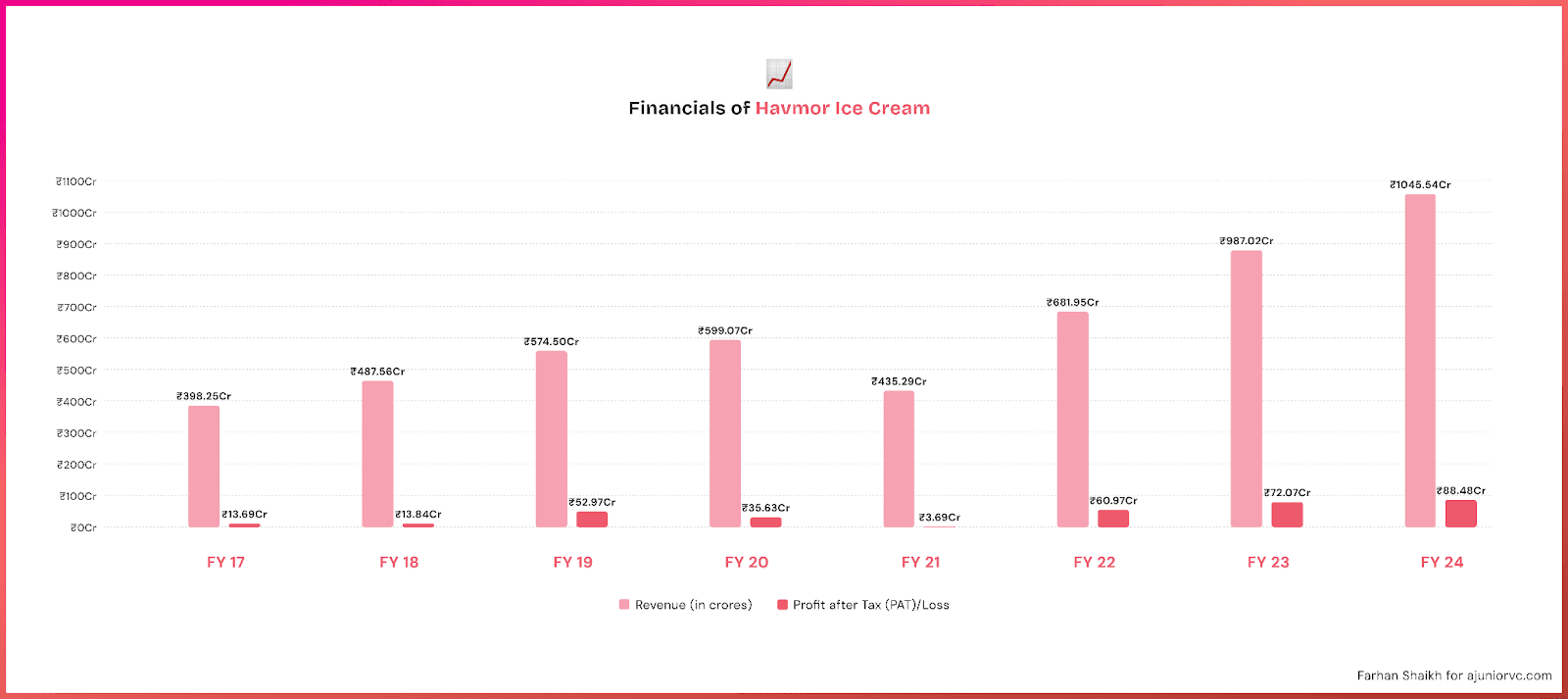
By FY16, Havmor crossed ₹450 crore in revenue, with 85% from ice cream and 15% from its restaurants. The following year, it hit ₹500 crore. What started as a handcart had become a Five billion rupee enterprise run by three generations.
But Ankit could see a new challenge on the horizon.
India’s ice-cream industry was expanding rapidly from ₹10,000 crore in 2010 to ₹20,000 crore by 2017. To compete nationally, Havmor needed deeper distribution, higher marketing budgets, and more capital than a family business could afford.
In 2017, South Korea's Lotte Confectionery knocked with an offer: ₹1,020 crore for Havmor Ice Cream.
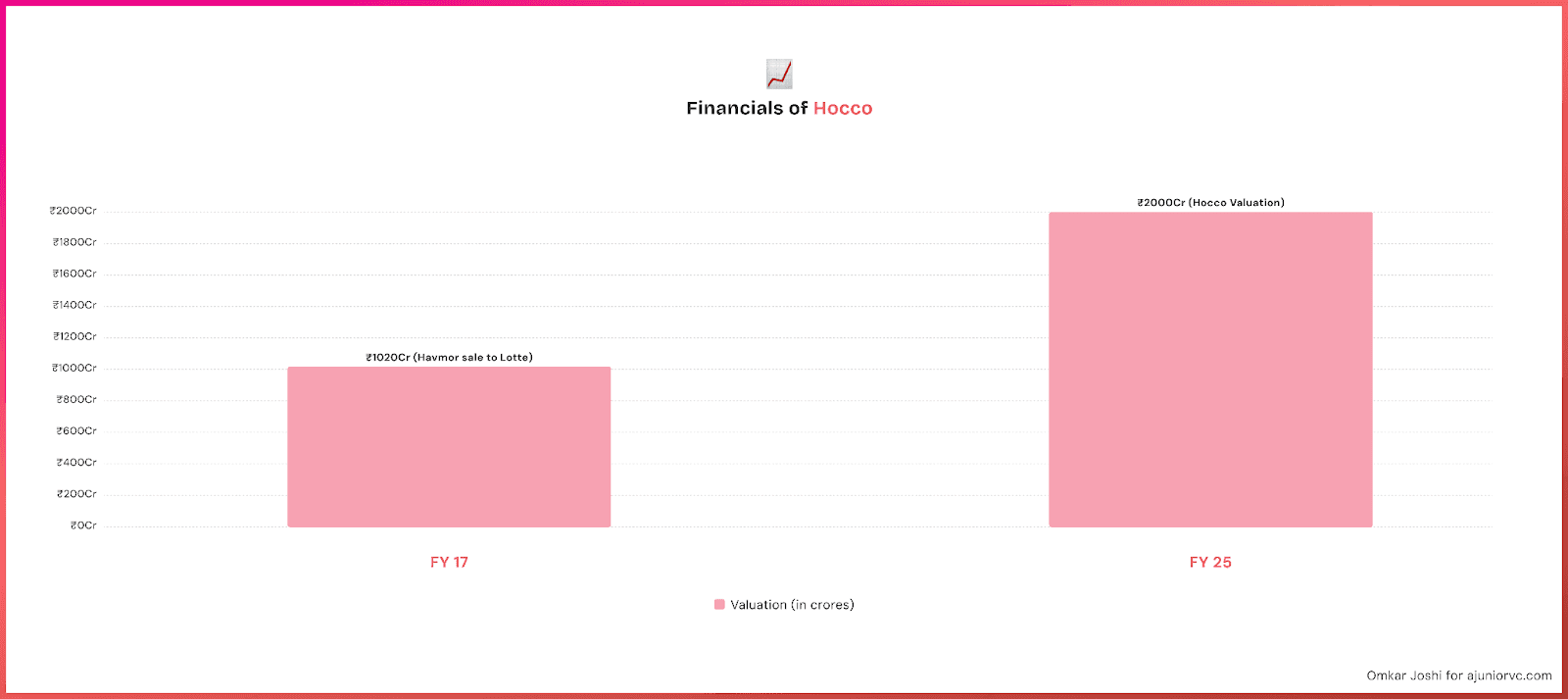
Ankit Chona, Satish's grandson and Havmor's Managing Director, described the decision as "emotionally brutal." But strategically, it made sense. Lotte had global reach, deep pockets, and a track record of scaling frozen dessert brands. The Chona family would cash out, retain the restaurant business, and step back.
Now, the brand was finally ready to go national, but not under his watch.
The deal closed in November 2017. The ice cream brand, the factories, and the distribution network all went to Lotte. The family kept one thing - the Havmor restaurant chain, which they immediately rebranded as HOCCO Eatery.
HOCCO stood for House of Chonas Collaborative, a hat tip to the family.
Then came the non-compete clause - five years. Like the mythical vanvaas, the Chona family could not create any ice cream brand, which they had done for longer than India had been a country.
Itch Wouldn't Quit
For most families, ₹1,020 crore would be the end of the story
Retire, invest. But the Chonas were not done.
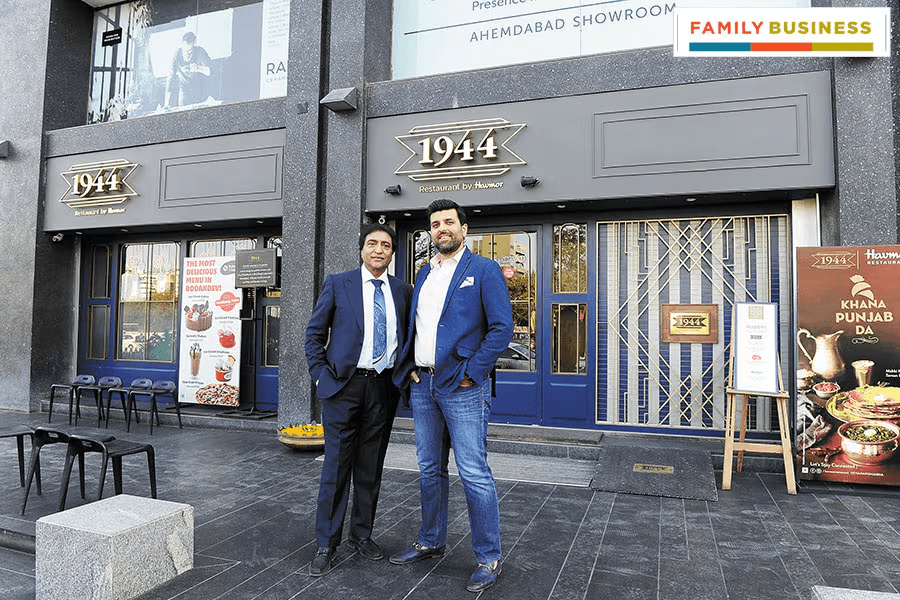
Instead, they doubled down on restaurants. By 2019, they operated 65+ HOCCO Eateries and had launched two new brands: 1944 The Hocco Kitchen (casual dining, North Indian/Punjabi) and Huber & Holly (premium ice cream parlours). The restaurant business was steady. But something felt incomplete.
The family had also noticed something interesting. Their restaurants served third-party ice cream, resulting in thin margins and no control over quality. What if they made their own?
In 2020, Ankit launched Phab, a healthy snack brand focused on protein bars and shakes. It was food, but not ice cream. The non-compete was still active.
By 2022, the non-compete clause expired, and Chonas made their move within months. In October 2023, HOCCO Ice Cream launched with a ₹100 crore manufacturing plant in Bavla, Gujarat.
The plant was built for scale. Initial capacity: 50,000 litres per day. Machinery imported from Italy and China. Packaging lines designed for speed. The goal wasn't to replicate Havmor—it was to compress 70 years of growth into 10.
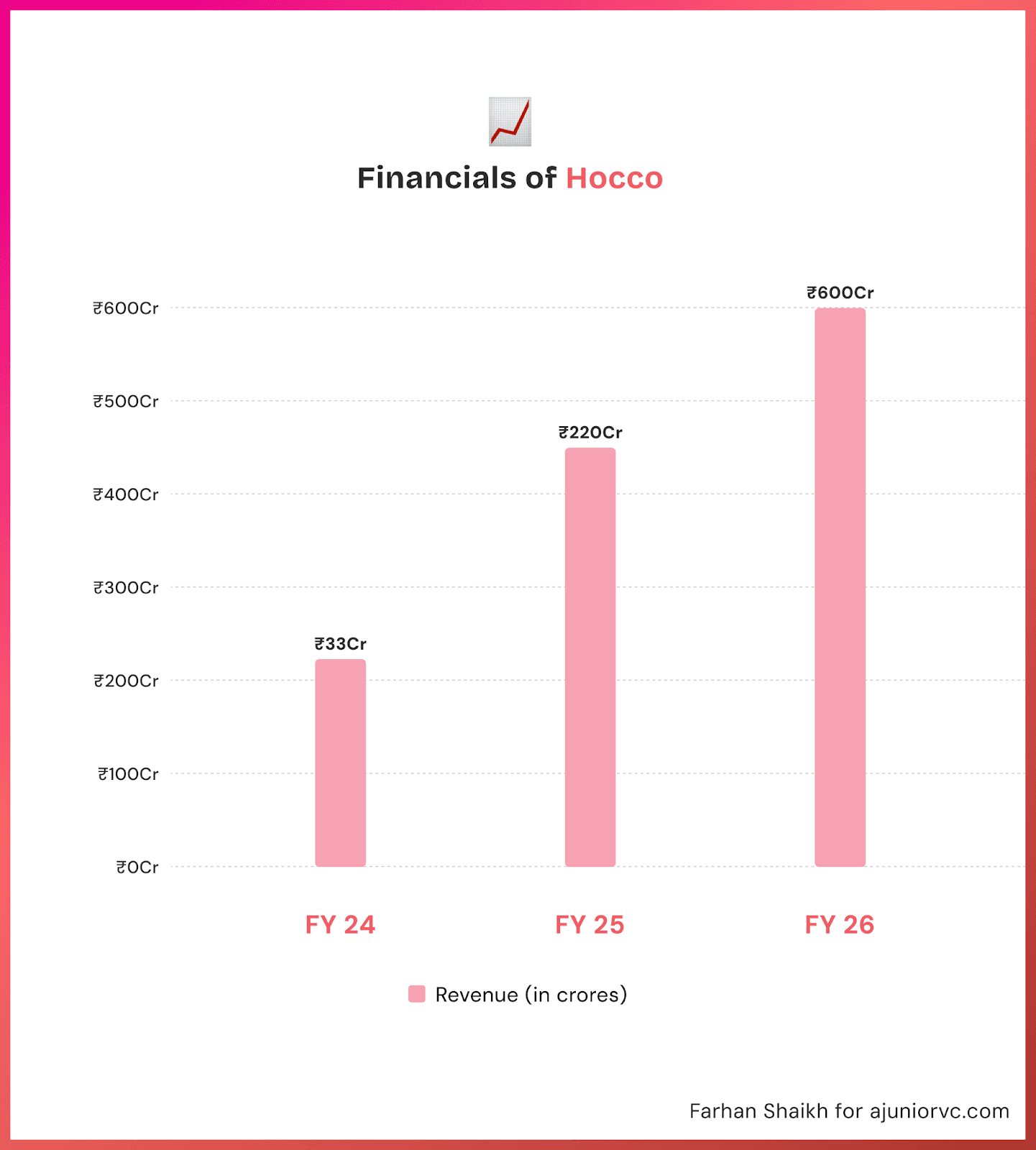
The early numbers were wild. HOCCO projected 15,000 litres/day by May 2024. They hit 50,000 litres/day instead. By FY25, the brand clocked ₹220 crore in revenue, nearly half of what Havmor took seven decades to achieve.
The math was straightforward.
The plant ran at 50,000 litres a day today, with plans to expand to 130,000 litres per day. Its range already spanned over 150 SKUs, from mass-market staples to premium offerings, distributed through more than 100 outlets, including HOCCO Eateries, franchises, and quick-commerce platforms.
By FY26, the company was targeting revenue of ₹420–450 crore, an astonishing compression of decades into literally a few years.
The business model had three interlocking pieces.
It began with the restaurant flywheel. Unlike Amul or Vadilal, which relied on third-party retailers, HOCCO controlled its own distribution through 65+ eateries. Every HOCCO Eatery became an ice cream parlour. Every meal ended with an upsell. The cleverness was in economics. A diner paying ₹300 for a meal would happily add an ice cream for ₹ 50. Incrementally, that's 15-20% order value lift with near-zero acquisition cost.
They then created a portfolio play: HOCCO wasn't just one brand. It was an ecosystem that served across the board. HOCCO Ice Cream focused on Mass-market cones, cups, and family packs (₹20-150). Huber & Holly concentrate on a premium parlour experience with gourmet flavours (₹150-300)
1944 The Hocco Kitchen operated casual dining restaurants with 14 locations. The HOCCO Eatery had a QSR format with 65+ outlets. HOCCO Ready-to-Eat was focused on packaged foods. In each, they were trying to go full-stack.
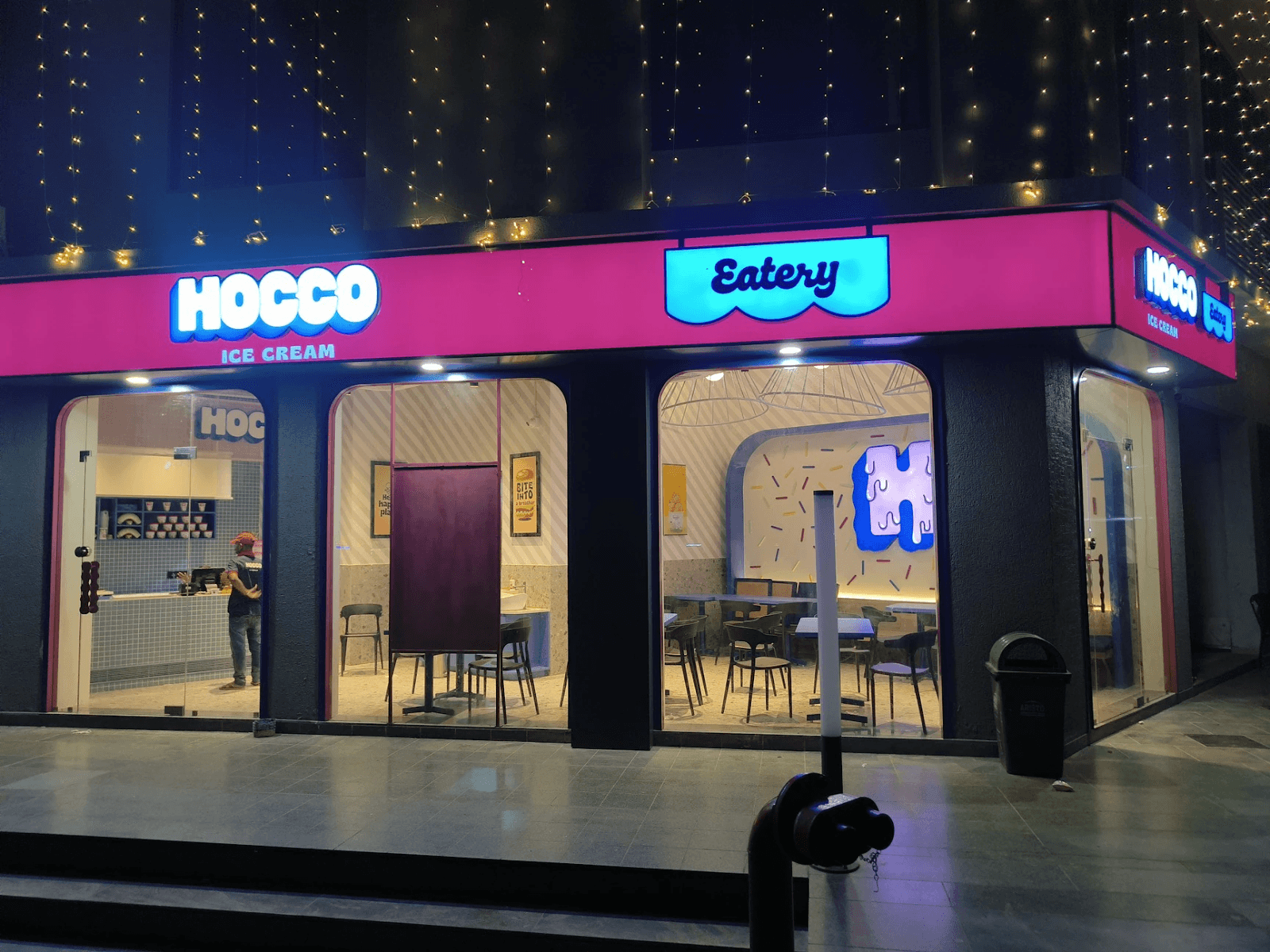
Each brand fed the other. A customer trying HOCCO ice cream at a restaurant might visit a Huber & Holly parlour for a premium experience. A Huber & Holly fan might buy HOCCO tubs from a quick-commerce platform for home use.
Finally, the new age edge: HOCCO launched with products designed for Instagram, and quick commerce. BIX was an Ice cream sandwiched between house-baked cake. Oh-Cone had cones topped with chocolate-coated balls. Healthies were Sugar-free range for health-conscious consumers.
All of this created the perfect situation for HOCCO to scale rapidly
Crowded Arena
India's ice cream market in 2024 was a ₹26,800 crore battlefield growing at 16% CAGR.
At the top sat Amul, with 40-45% market share. Its strategy was entirely mass-market. Amul had brutally efficient pricing (₹20 cones) and a distribution network that reached every kirana in India. Amul was the Maruti of ice cream, ubiquitous, affordable, unshakeable.
Next came Vadilal, commanding 15-20% with over 150 flavours and a franchise network across Gujarat and Rajasthan. Founded in 1907, Vadilal had institutional memory and regional loyalty that money couldn't buy.
Kwality Walls (Hindustan Unilever) held a single-digit share but carried global brand equity. Cornetto, Magnum, and premium formats gave HUL a differentiated play, even if volumes lagged.
Then there were the regionals: Mother Dairy in Delhi-NCR, Hatsun's Arun in Tamil Nadu, Cream Bell in Maharashtra.
Finally, there insurgents. New-age brands like Hangyo, Go Zero, NIC Ice Creams, and Naturals were carving niches with preservative-free, artisanal, and health-forward positioning. Funded by investors, these brands were growing 30-50% year-on-year by targeting Gen Z and affluent millennials.
HOCCO sat at the intersection.
It had Vadilal's regional strength, HUL's premium ambitions, and the new-age insurgents' innovation DNA. But unlike pure-play ice cream brands, HOCCO's restaurant backbone gave it a structural advantage, guaranteed distribution.
In 2024, quick commerce had become the secret weapon.
Quick commerce collectively accounted for 10%+ of ice cream sales for major brands. For HOCCO, quick commerce was even more critical, it extended reach beyond Gujarat without requiring brick-and-mortar expansion.
A user in Delhi-NCR could order HOCCO and have it delivered in 10 minutes. No need for a physical store. No cold chain logistics to manage. Just pure velocity.
The economics were favourable too. Quick commerce platforms took 15-20% commission, but eliminated distributor margins (typically 8-10%) and retailer margins (20-25%). Net-net, brands retained similar or better margins while reaching 10x the audience. HOCCO's quick commerce strategy to flood the top metros first, then cascade into Tier 2.
By mid-2024, HOCCO was live on all major platforms in Delhi-NCR, Mumbai, Pune, and Bangalore. The plan was to add 50+ cities by 2025.
But quick commerce had a trap.
Unlike kirana counters, where shopkeepers pushed higher-margin SKUs, quick commerce was a free-for-all. Customers searched by price, not brand loyalty. A ₹50 HOCCO cone competed directly with a ₹40 Amul cone. Winning required either brand pull or constant discounting.
HOCCO chose brand pull.
Funding Machine
In June 2024, HOCCO raised ₹100 crore ($12M) from the Chona Family Office and Sauce.vc, valuing the company at ₹600 crore.
Leveraging the wealth created through Havmor, the Chona family was funding its new venture. Why was it funding its own company? As new investors entered and diluted equity, the Chona family wanted to retain its ownership. This was done by investing at the same valuation as the round.
The round valuation was unusual. Despite being less than a year old, HOCCO commanded a valuation higher than most Series B startups. The reason was proven execution, family credibility, and explosive early traction.
By September 2025, HOCCO raised another 150 Cr in Series B, pushing the valuation to ₹1,440 crore.
The capital would fund three things: Capacity expansion going close to 2L litres/day, geographic expansion with a Deep push into Maharashtra, Rajasthan, UP, Punjab, Chhattisgarh and cold chain infrastructure which meant owning distribution instead of relying on third-party logistics
The family's game plan was clear, reach ₹1,000 crore revenue by FY28. That would make HOCCO the fastest-growing ice cream brand in Indian history and 2x as large as Havmor ever got under family ownership.
Fighting Ahead
By 2025, HOCCO had proven velocity. But velocity isn't victory.
The real test would be margin sustainability. Ice cream is a notoriously low-margin business. Raw materials (milk, sugar, stabilizers) account for 40-50% of costs. Manufacturing and cold chain add another 15-20%. Distribution takes 8-10%. Marketing, overheads, and wastage eat the rest.
Most ice cream brands thus operate on 8-12% net margins.
HOCCO's restaurant integration gave it a structural edge, captive distribution meant lower customer acquisition costs and higher throughput per outlet. But scaling beyond Gujarat would test that advantage. In Maharashtra, HOCCO would compete with Cream Bell's established network. In UP, local cooperatives dominated. In Delhi, Mother Dairy and Amul were entrenched.
The other challenge was seasonality. India's ice cream market sees 60-70% of sales concentrated in March-August. Brands that can't drive winter consumption struggle with idle capacity and cash flow gaps. Hocco’s portfolio diversification helped it win.
Could the family’s second innings be bigger than Havmor? The hunger to scale has not gone away.
The market is there. India's ice cream consumption is still criminally low, 0.4 litres per capita vs. 12+ litres in the US. As incomes rise and cold chains improve, the category will 5x by 2033.
The family is driven. Ankit Chona has publicly stated his goal, which was to achieve in 10 years what Havmor took 70 years to build
The numbers say potentially.
HOCCO's FY25 revenue of ₹220 crore puts it at 0.8% of India's ice cream market. To hit ₹1,000 crore by FY28, it needs to sustain 50%+ growth for three consecutive years. Possible, but rare.
The real differentiator will be whether HOCCO can crack national brand status without losing its local soul. Amul did it by staying affordable. Vadilal did it by franchising aggressively. HUL did it with Unilever's distribution muscle.
If the flywheel works, HOCCO could become India's first full-stack ice cream ecosystem, not just a product, but a way of life.
The ice cream wars are going to get hotter as more players emerge into the mix. New brands serving India’s vast consumer market, and the older ones fighting for space. But the transition from Havmor to Hocco is unique.
The HOCCO story has done something most families never do.You can sell your legacy, walk away, and come back stronger. The handcart on Relief Road that Satish Chona pushed in 1951 is long gone.
But the recipe and the resolve never left, ready to win you with one more ice cream.